


The US-Iran Quagmire and Pakistan

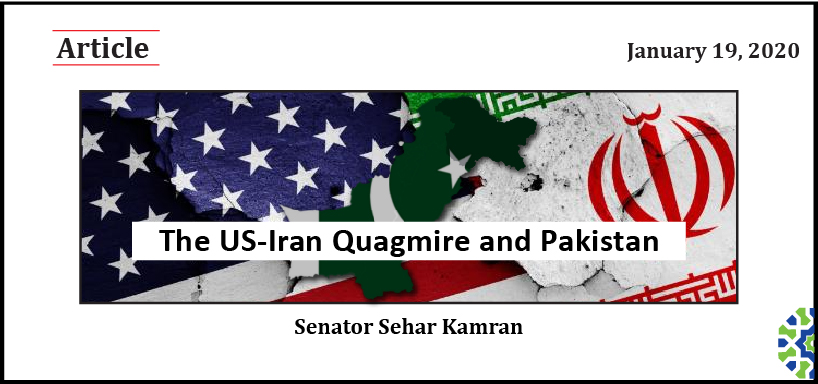
Commentary by Senator Sehar Kamran T.I.
Jan 22, 2020
[responsivevoice_button rate=”1″ pitch=”1.2″ volume=”0.8″ voice=”US English Female” buttontext=”Listen to Post” ]
 “Peace is the virtue of civilization; war is its crime”: -Victor Hugo
The year 2020 started with a literal bang. Blazing fires across Australia and the US and Iran tensions, with the two countries almost at the brink of a war captured the news headlines across the globe, for the first half of January. The raging clouds of war seem to have simmered away, as of now, but the tension continues to linger in the Middle East. With every passing day, the uncertainty and confusion is gaining momentum, and the world is waiting with a bated breath to see where this heightened tension in the US-Iran relations is heading towards.
It is no secret that Iran has been under severe international pressure and sanctions, directly for the last two decades at least. Tensions in the US-Iran bilateral relations have been simmering since last year, when the US unilaterally abandoned the Joint Comprehensive Plan of Action (JCPOA) signed between Iran and the P5+1 in 2015 following over a decade long diplomatic endeavors, and imposed strict international sanctions against Iran which have crippled its economy.
The US drone attack which resulted in the assassination of Iranian General Qasem Soleimani, of the elite Quds Force, in Baghdad on 3rd January has not only amplified the strain in the already tense US-Iran relations but also depicted how fragile the regional peace is. What is more shocking is the fact that two attacks were planned on the day General Soleimani was killed. The other attack was targeted against Abdul Reza Shahlai, a senior Iranian Commander, in Yemen but it remained unsuccessful. These two simultaneous events jolted not only Iran but also the region and the whole world because it was seen by many as an intentional act of war.
In retaliation to the American drone strike, Iran fired 22 missiles targeting two American bases in Iraq. Initially the US President and Pentagon denied any injuries or deaths, the US military on 16th January stated that 11 of its soldiers were wounded, as a result of the retaliatory strikes by Iran.
Iran’s Defense Minister issued a statement on 17th January asking the US not try to test the Iranian people’s resolve because the missile attack on the US base was just a “warning” and “in self-defense,” and Iran was “prepared to give a powerful response to any adventurism.”
Following the Iranian attacks, President Trump in a live televised address to the nation threatened to “target 52 Iranian sites” including cultural centers, and announced more “punishing” economic sanctions against the country. However, the US officials later back-tracked and President Trump toned down the war rhetoric by tweeting “all is well”.
When it seemed that the war cries had slowed down, a Ukrainian commercial airliner in Tehran was accidently shot down by the Iranian military on 8th January consequently worsening the already tense situation. The passenger jet was carrying 176 persons on board who were all killed. Initially, Tehran denied the news and dubbed the allegations as a part of US’s “psychological operations” against Iran. However, on 11thJanuary, Iran’s President Hassan Rouhani tweeted that an Iranian internal investigation had found that the missiles had been fired due to human error, and described the missile attack on the plane as an “unintentional” and “unforgivable mistake”. Many observers viewed this statement as a step on part of Iran towards de-escalation in the tensions in the region. However, the situation continues to be tense and remains explosive warranting serious and meaningful diplomatic efforts. What cannot be denied is the fact that the 176 people who died in the air crash were the unwarranted victims of the US-Iran tensions.
Another factor that needs to be examined in this ‘heating of tensions’ scenario is the upcoming Presidential election in the US. It seems that President Trump intends making anti-Iran rhetoric as part of his campaign. Echoes of starting a new war are being heard in Washington, and as a result the US Congress led by Democrats, passed a resolution on 9th January, to curb President Donald Trump’s powers of waging war against Iran. Although it doesn’t carry the force of law, the measure calls for President Trump to stop use of military force against Iran within 30 days if he does not have congressional approval. On 11th January, 13 US lawmakers including Bernie Sanders and Kamala Harris, introduced a “No War against Iran Act”, which would deny the Pentagon of any funds for unauthorized use of military force against Iran.
However, there is one certainty that the proxy war in the Middle Eastern theatre is likely to intensify in the coming days especially in Iraq, Syria and Yemen. US’s Middle Eastern allies will be on high alert because there is a danger of Iranian backed militants’ attacks on strategic targets and US bases across the region. Due to retaliatory attacks, it will cause further chaos and instability in the region and the world.
Iran is Pakistan’s Western neighbour and the two countries share a 959 km long border. Though Pakistan has stated that it will not “take part in anyone else’s war”, and will stay neutral, but it is quite possible that in case of an armed conflict between Washington and Tehran, the country will be badly impacted. Pakistan cannot take sides in the war between its strategic partners including the US as well as its consistent Middle Eastern allies and its brotherly neighboring country, Iran. Moreover, Pakistan houses the second highest Shia population in the world. With fragile economy, burning domestic issues and societal divide, the country cannot afford to take sides in a conflict which can ignite a sectarian warfare inside its borders.
Furthermore, Islamabad is already engaged on its Eastern border with India and has tense Western border with Afghanistan, and it cannot get involved on another front. In addition, the country is already grappling with the menace of violent extremism and radicalism, another misadventure by global powers will only make matters worse, for the entire region. The region which is already in turmoil cannot afford to have another armed conflict.
In the light of these events, Pakistan’s Foreign Minister undertook a whirlwind tour of Iran, KSA, and the US to defuse tensions and discuss the Middle East crisis, but there is a limitation as to how much and how effective a role can Pakistan play to defuse the tensions in these crucial times.
In a statement and press talk Pakistan Foreign Minister Shah Mahmood Qureshi has stressed on Islamabad’s commitment toward “security and stability” in South Asia as he met US Secretary of State Mike Pompeo and held talks on various issues, including regional security and stability, the situation in Afghanistan and the Middle East. However, the recent tweet of US Secretary of State Mike Pompeo reads, “Enjoyed meeting with Pakistani Foreign Minister @SMQureshiPTI today. We discussed countering Iranian aggression, the Afghan peace process, trade ties, and regional stability”.
The Tweet message of Secretary Mike Pompeo has raised concerns and generated new debate in Pakistan on US’ anticipation about Pakistan’s role “countering Iranian aggression”. Moreover, it is sad that there is no mention of ‘Kashmir crisis’ in the Pompeo’s message.
People of Pakistan are not ready to face another crisis and accept a US “Do More” mantra. It is high time for Pakistan to focus on domestic issues, maintain internal stability, promote political and institutional harmony, evolve national unity and elicit public trust. At the same time, it is significant that the country stays away from regional quagmires which will only bring more problems.
The international community needs to play its role to avert any such misadventures by big powers which will destabilize the entire world. War is in nobody’s interest. The world is already burning. The world needs no reminders how devastating a war can be, and how it can hamper international peace and security. Humanity needs to come together and prevent another disaster in the making. Sanity must prevail, otherwise the fate of this world will be nothing but death and destruction.
The writer is the founder and Patron in Chief of a non-partisan think tank; the Centre for Pakistan and Gulf Studies (CPGS), she is a prominent politician, academician and practitioner in the areas of regional, international defense and strategic studies. She has served as an elected Member of the Upper House of Parliament of Islamic Republic of Pakistan from 2012-2018, until May 2019 she was the Member Senate of Pakistan Forum for Policy Research (SFPR). She has also remained the member of Senate committees on Defence, Foreign Affairs, Human Rights and the convener of the Pakistan-Saudi Parliamentary Friendship Group at the Senate of Pakistan. Twitter @SeharKamran