


Pakistan – US; A Sinuous Road that Never Ends

By Adeela Bahar Khan
Nov 1, 2013

Pakistan plays a significant role strategically, not only in South Asia but also in the global arena. Because of its strategic position in the war on terror, it has increasingly been viewed by American officials, in the context of the situation in Afghanistan, as a major partner in the campaign to destroy Al Qaeda and the Taliban network and now looking forward for assistance in successive transition from Afghanistan in 2014.
The 66 year history of relations between the United States and the Islamic Republic of Pakistan has been manifested by alternate periods of courtship and of distrust. Following 9/11 however, there has been a twist in these relations, and Pakistan and the US have since developed very close working ties. During the 12 years of this war, Pakistan has lost more than 40,000 innocent human lives as well as faced massive economic losses. The causalities of military and paramilitary troops have been raised each day which is more than any other U.S. ally in the war on terrorism.
U.S.-Pakistan engagement may be focused on cooperation in the war on terrorism, but it is not limited to it. As this the American war not the Global War or Pakistani war. However, Pakistan faces serious dilemmas in its partnership with the US. The security situation in the country is deteriorating day by day; suicide bombings, drone attacks, terrorist attacks and violation of human rights which raises instability in Pakistan and US. The US government faces serious and multiple challenges because of its own public. The massive killings in Afghanistan upraised the public proclaimed to stop further deployment of its forces to other countries
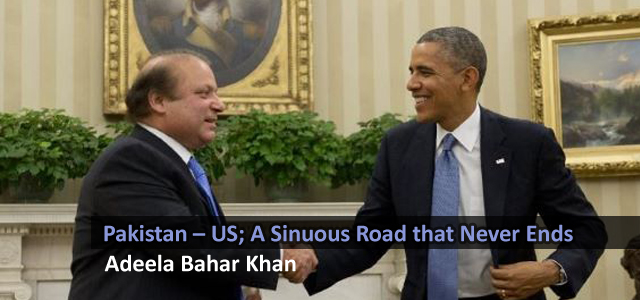
The people of yesteryear believed that no productive ties could ever develop between Pakistan and USA. This fact is visible even amongst the moderates in Pakistan who generally perceive Pakistan merely as an ally in a futile war and a country that has suffered immensely from the tide of rising extremism in Pakistan and its neighborhood. This perception exists despite the American leadership’s reassurances to Pakistan’s Prime Minister Mian M Nawaz Sharif during his visit to the US that while differences exist on certain issues, the US will continue to support Pakistan in every hardship and not abandon the region following the military pullout in 2014. The fact remains however that the States has chosen to act in self-interest over regional interests time and again, lending little credibility to such reassurances.
Since 2001, Pakistan has received large amounts of financial aid for security, support and development programs. Despite this assistance, Pakistan remains overburdened with the problems of increasing poverty, a growing energy crisis and of course, terrorism. The post 2014 Afghan transition is a new cause for alarm and concern for Pakistan. The Obama Administration recently released a further USD 1.6 billion in aid during the visit of the Prime Minister to the US with the hope of strengthening cooperation on issues of mutual concern, such as energy, trade and economic development, regional stability, revival of Strategic Dialogues and countering violent extremism. This move also indicates the need of support by Pakistan during and for a successful transition in Afghanistan, as the process will involve more than 70 percent of Pakistan’s land routes for logistic movement and 30 percent of northern land routes.
Both countries now face an enormous task ahead — how to bridge the trust deficit that is crucial for establishing stability in the region, as many in Pakistan continue to doubt the sincerity and aims of U.S. policies in the region. A new foundation needs to be laid for a productive US-Pakistan relationship. Market access and trade agreements are a good start, but the process needs an implementable action plan for long term success. Both countries need each other more than ever before, particularly in light of the emerging post-2014 scenarios, where Pakistan can play a positive role in maintaining global peace and ensuring stability in Afghanistan. With this one point in focus, both countries must move together and look ahead to face the challenges posed.