


Pakistan and SCO Building: Common Understanding


Pakistan – Iran Relations: Prospects & Challenges
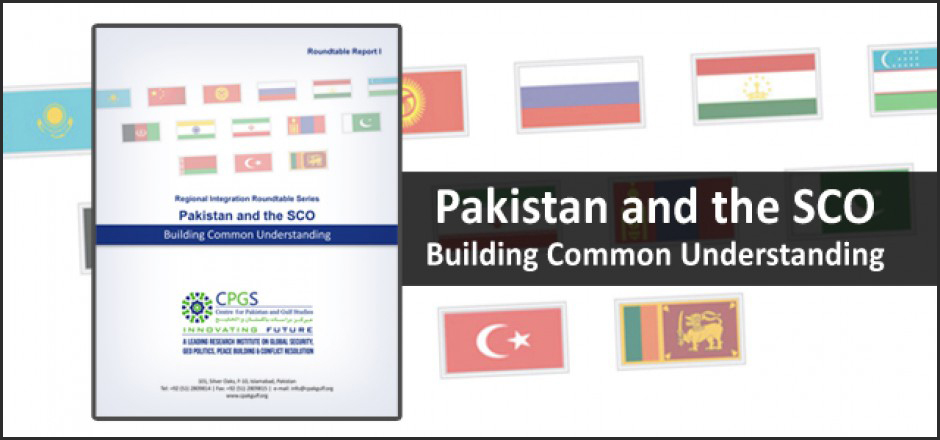
The Centre for Pakistan and Gulf Studies (CPGS) is a non-partisan research institute established with a vision to innovate future prospects for peace and security in the region and beyond through undertaking research on global security, geo-politics, peace-building and conflict resolution. To this end, CPGS, in collaboration with Konrad Adenauer Stiftung (KAS), organized a roundtable discussion titled, ‘Pakistan and SCO: Building Common Understanding’, at the CPGS office.
The roundtable was organized as part of the Centre’s ongoing project on ‘Regional Integration: Road to Peace and Prosperity’, which aims at promoting a common understanding on issues of mutual interest and explore avenues of cooperation, amongst the states of South and Central Asia. The roundtable intended to enhance understanding about the significance of Shanghai Cooperation Organization (SCO) in promoting regional connectivity and building understanding of the benefits for prospective members like Pakistan, and the impact of their membership on the organization as a whole. Two esteemed experts – Ambassador (R) Akram Zaki, Former Secretary General for Foreign Affairs, Pakistan and Dr Mavra Innayt, Assistant Professor, School of Politics and International Relations (SPIR), Quaid-e-Azam University (QAU) – discussed at length the various aspects of the prospective membership of Pakistan in the SCO. The discussion was chaired by General (R) S. M. Owais HI(M).
The roundtable delved into the history of the SCO, its core objectives, relevance in the world order as well as prospects for Pakistan’s membership of the SCO and possible avenues of cooperation.
The SCO is increasingly becoming significant both in regional and international affairs, due primarily to the following two reasons. First, the SCO states have vast natural energy reserves; second, they are a huge market for foreign exports and the third is their increased geopolitical significance in the Global War on Terror (GWoT). While initially the SCO focused more on internal security aspects – like the separatist and Islamist movements inside the member countries, currently its interests have expanded and are predominantly shaped by economic interests, regional connectivity and energy trade.
The SCO’s security and economic interests are now expanding to the South Asian region. Nonetheless, the collective desire to tackle non-traditional security challenges remains at the heart of the SCO coordination. During the last summit, for example, SCO countries focused on the situation in Afghanistan and matters relating to the extension of membership to Pakistan, India, Afghanistan and Iran, in addition to the usual agenda items of regional stability and economic development issues. This trajectory of the SCO agenda also highlights the intention of the current SCO states to develop a regional trade hub that includes Pakistan and its three neighbors; India, Afghanistan and Iran.
[column col=”1/4″]Chair[/column][column col=”3/4″]Senator Sehar Kamran (T.I.)[/column]
[column col=”1/4″]Speakers[/column][column col=”3/4″]Ambassador (R) Akram Zaki
Dr Mavara Inayat [/column]
[download file=”http://cpakgulf.org/wp-content/uploads/2015/06/SCO_Regional-Integration-Roundtable-Series1.pdf” title=”SCO Regional Integration Roundtable Series”]